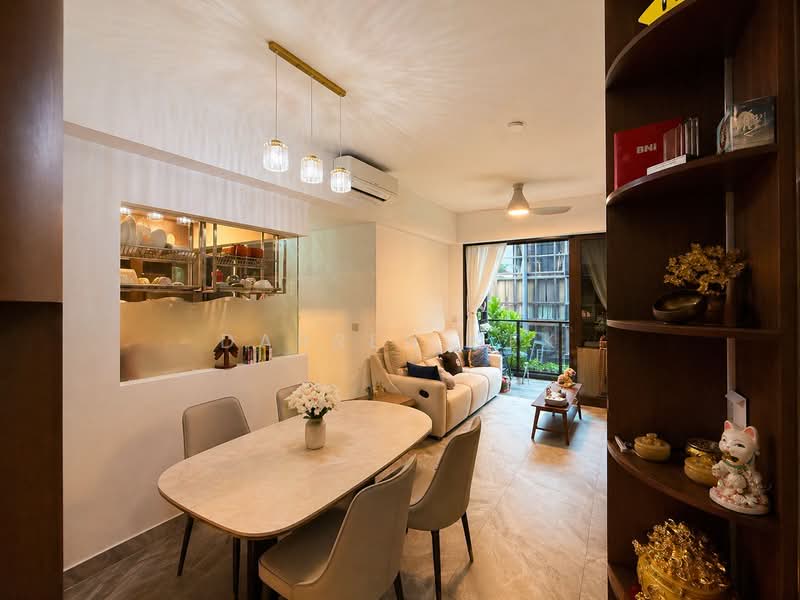
1 properties in The Commodore
The Commodore's location just 230 metres from Canberra MRT Station positions it excellently within the North-South Line corridor, which is one of Singapore's most established and stable transport networks serving both residential and commercial zones. Properties within 5 minutes' walk of MRT stations typically command a 15–20% premium over non-MRT-proximate developments, making this a significant value advantage for both owner-occupiers and investors. The Canberra area has demonstrated consistent rental demand from young professionals and families seeking convenient access to the CBD and educational institutions, supporting strong medium-term appreciation potential.
Based on current market conditions in the Canberra precinct, well-maintained condominium units can achieve gross rental yields of 2.8–3.5% annually, depending on unit size and finishes, which aligns competitively with North-South Line corridor benchmarks. The primary tenant demographic comprises young working professionals aged 25–35, expatriates on company housing assignments, and small families seeking proximity to schools and transport; this segment demonstrates lower vacancy risk and more stable lease terms. Investors should market units emphasising convenience to business districts via the MRT and access to nearby educational institutions, as these factors significantly influence rental competitiveness in this micro-location.
Foreign investors purchasing at The Commodore will incur Additional Buyer's Stamp Duty (ABSD) at 20%, adding approximately S$326,000 to the S$1.63 million sample listing price, materially compressing first-year cash-on-cash returns and requiring longer hold periods to justify the investment. Singapore citizens or permanent residents buying this as a second residential property face ABSD at 15%, adding approximately S$244,500, whilst first-time buyers of Singapore citizenship enjoy ABSD exemptions, making them the most capital-efficient purchaser profile. Investors must factor these upfront costs into their yield calculations, typically requiring gross rental yields above 4% to achieve acceptable net returns after accounting for ABSD, financing costs, and property management fees.
As a contemporary condominium development, The Commodore would typically be launched with a 99-year lease, which provides strong long-term value security and poses minimal financing or resale concerns for the next 30–50 years. However, buyers should verify the exact lease commencement date and obtain legal documentation confirming the tenure, as lease length directly impacts both financing eligibility (most banks require minimum 60–70 years remaining) and future resale appeal. Properties with leases falling below 80 years can experience accelerated value depreciation and reduced buyer interest, so understanding this parameter is essential for long-term investment planning, particularly for investors with 20+ year horizons.
The Commodore's asking price of S$1.63 million positions it within the upper-mid range for newer condominiums along the North-South Line, reflecting both its modern specifications and prime MRT proximity; comparable developments in the Orchard-Novena segment typically command S$1.5–2.2 million for similar unit types. Current market conditions (as of mid-2024) show stabilisation after the 2022–2023 correction, with select pockets like the Canberra area experiencing renewed interest from both owner-occupiers and investors seeking value relative to central locations. For long-term owner-occupiers with strong affordability, the current market window offers reasonable entry pricing; however, investors should exercise caution and conduct thorough due diligence on comparable rental yields versus alternative MRT-proximate micro-locations before committing capital.
For a S$1.63 million purchase price, owner-occupiers can typically access 80% LTV financing (approximately S$1.304 million loan quantum), whilst investors are generally restricted to 75% LTV (approximately S$1.223 million), requiring larger equity down payments and higher liquidity reserves. Monthly mortgage servicing for an 80% LTV loan at prevailing rates of 4.2–4.5% over a 30-year tenure would equate to approximately S$6,200–6,500, making debt serviceability a critical screening criterion for buyers; most banks require monthly household income to be at least 30% of the total mortgage amount. Buyers should also factor in stamp duty (3–4%), legal fees (0.5–1%), and property agent commissions (1–1.5%) totalling approximately S$65,000–80,000 in transaction costs, which materially impacts overall capital requirement and should be budgeted separately from down payment reserves.
Buyers should obtain and thoroughly review the Deferred Payment Scheme (DPS) or progressive payment structure, if applicable, to understand cash flow timings and potential penalties for late payment; they should also verify the defects liability period (typically 12 months post-completion) and confirm that the developer maintains adequate insurance coverage during the construction and defects periods. Conduct a professional building inspection to assess construction quality, check for any water seepage in bathrooms or kitchens, inspect structural elements in common areas, and verify that all mechanical and electrical systems are functioning correctly and appropriately certified by licensed professionals. Additionally, buyers must review the estate's financial statements and sinking fund adequacy, obtain copies of the Management Corporation Strata Title (MCST) minutes for any ongoing disputes or major works, and confirm real property tax assessments to avoid unexpected annual expense increases after purchase.
The Canberra area has limited nearby completed or under-construction residential developments, which supports a relatively tight supply environment and reduces direct competitive pressure on rental and resale pricing for The Commodore. However, the broader North-South Line corridor (particularly around Novena and Bishan stations) has several ongoing residential projects in various stages, which could incrementally absorb rental demand and moderate price growth if multiple developments complete simultaneously. Savvy investors should monitor the Urban Redevelopment Authority's (URA) master plan updates and any government land sales announcements near Canberra, as future large-scale residential or mixed-use developments could either reinvigorate the micro-location or create alternative supply that fragments tenant demand.
The 3-minute walk to Canberra MRT Station typically justifies a 15–25% pricing premium over comparable condominiums 10–15 minutes' walking distance from transit, translating to approximately S$240,000–410,000 in additional value at The Commodore's price point; this premium is particularly pronounced for young professionals and expatriates whose transport costs and time savings provide measurable financial and lifestyle benefits. Whilst MRT-proximate developments often allocate space to transport access rather than amenities, modern projects like The Commodore generally balance this trade-off by incorporating communal facilities (gyms, pools, gardens, co-working spaces) that compete effectively with suburban alternatives. For investors, the MRT proximity dramatically reduces tenant vacancy risk and provides downside protection during market downturns, as rental demand remains resilient amongst the segment prioritising connectivity over amenity density.
Investors should track quarterly price indices for the North-South Line corridor (available through Urban Redevelopment Authority and real estate analyst reports) and monitor year-on-year rental growth rates; if annual rental yield expansion exceeds 3–4%, it signals strong tenant demand and may justify extended holds, whereas stagnant yields indicate potential market saturation. Key external signals include interest rate movements from the Monetary Authority of Singapore, mortgage rate trends from major banks, and government policy changes (e.g., ABSD adjustments or cooling measures), all of which directly impact buyer demand and financing accessibility. Investors should establish clear exit triggers—such as achieving a 25–35% total return (capital appreciation plus cumulative rental income) over a 7–10 year hold, or observable deterioration in tenant demand or rental rates—and periodically reassess the investment thesis against alternative asset classes and geographic micro-locations.
Free Property Valuation
Enter your postal code and get a free instant valuation report straight to your inbox.