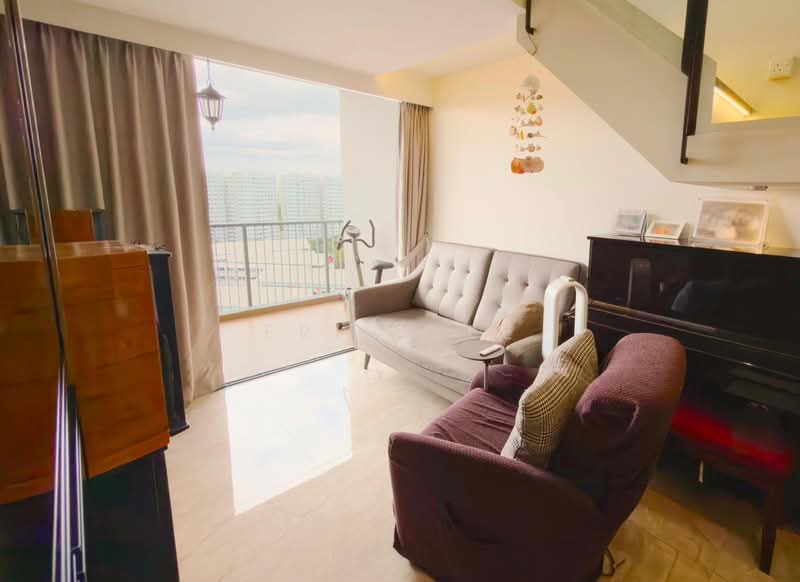
1 properties in Kingsford Waterbay
Kingsford Waterbay presents a compelling opportunity for long-term investors and owner-occupiers despite recent cooling measures, as the development is located in the emerging Serangoon area which has seen significant infrastructure investment and population growth. The project's proximity to Kangkar LRT station positions it well for future capital appreciation, particularly as the North-East Line extensions continue to improve connectivity in the region. However, investors should note that additional buyer's stamp duty (ABSD) of 15% applies to non-citizen purchasers and 5% for citizen investors with existing properties, which materially impacts entry costs compared to the broader market, so careful financial planning is essential.
At approximately S$1.6 million for a 3-bedroom penthouse, Kingsford Waterbay's pricing sits at a competitive level relative to nearby developments like Sungei Bedok and Fernvale Link, though the exact price per square foot depends on unit configuration and floor plate size. The development's waterfront positioning and integrated amenities justify a modest premium over standard district developments, but it remains more affordable than trophy properties in prime fringe areas like Katong or Marine Parade. Investors should benchmark against recent comparable transactions in the Upper Serangoon and Buangkok areas to accurately assess value proposition, as this relatively new precinct is still establishing its market positioning.
Kingsford Waterbay is ideally suited for young professionals and growing families seeking a balance between accessibility, modern amenities, and affordability, particularly those working in the eastern or north-eastern employment corridors who benefit from proximity to Kangkar LRT. The development also appeals to buy-to-let investors targeting the rental demographic of young working adults and expatriates who prioritise convenience and waterfront living, as the proximity to transport and education institutions makes it attractive to tenants. Owner-occupiers with a longer investment horizon (7+ years) will benefit most, as the area's ongoing infrastructure development and population growth support both rental yield and capital appreciation potential.
Based on current market rents in the Serangoon corridor, investors can reasonably expect gross rental yields of 3.0% to 3.5% for a unit at Kingsford Waterbay's price point, assuming monthly rents of approximately S$4,000 to S$4,500 for a quality 3-bedroom unit. Vacancy risk is relatively moderate compared to more saturated districts, though the local precinct remains relatively new and rental market acceptance is still maturing—investors should factor in potential void periods of 4-8 weeks between tenancies as the area builds critical mass. The main risk factors include oversupply in the short to medium term if multiple phases of the development are launched simultaneously, and potential competition from alternative developments as more projects complete in the eastern corridor.
The 1.2 km proximity to Kangkar LRT, representing approximately 14 minutes' walk, positions Kingsford Waterbay within the highly desirable 'accessible' category that commands a rental and resale premium compared to non-MRT-proximate developments in the same price range. Properties within walking distance of LRT stations typically attract 10-15% higher rental demand and achieve faster leasing cycles, which directly improves yield stability and capital preservation for investors. This connectivity advantage is particularly pronounced for younger renters and working professionals, making Kingsford Waterbay an attractive proposition compared to similarly-priced developments further from public transport, though the premium is more modest than ultra-prime MRT-adjacent locations in central districts.
For a Singapore citizen investor with no prior property ownership, ABSD of 5% applies to the S$1.6M purchase price, resulting in additional duty of S$80,000, plus standard conveyancing stamp duty of approximately S$14,400, bringing total acquisition costs to roughly S$94,400 plus legal fees. For non-citizen investors, ABSD rises to 15% (S$240,000) plus stamp duty, making the total acquisition cost approximately S$254,400, which significantly impacts the investment return threshold and minimum holding period required for positive cash flow. It is advisable to consult with a tax advisor to optimise the purchase structure, particularly if the investor holds multiple properties or has complex tax residency circumstances, as these duties can materially affect investment viability.
New launches at Kingsford Waterbay will typically be offered on 99-year leases, which is standard for new condominium developments in Singapore and poses no material concern for most buyers with a typical 30-35 year holding horizon. However, buyers with an ultra-long-term perspective (40+ years) should be aware that lease decay will eventually impact resale value and mortgageability, with lenders typically becoming more restrictive once leases fall below 70 years remaining. The 99-year lease tenure provides sufficient longevity for wealth building and retirement planning purposes, though investors should factor in potential future lease extension costs (if available) or re-development scenarios once the lease profile becomes more mature, typically 50-60 years into the lease.
The Serangoon and Upper Serangoon area has several development projects in the pipeline, including potential residential sites released through Land Sales, which could introduce meaningful supply competition within the next 2-5 years and potentially moderate capital appreciation rates. However, strong population growth drivers—including upgrading of existing Housing and Development Board estates, ongoing transport infrastructure expansion, and emerging commercial clusters around Serangoon Central—suggest sustained medium-to-long-term demand that can absorb new supply. Investors should monitor URA's planning announcements and Land Sales schedules to understand potential pipeline projects, as this will inform realistic expectations for capital growth; typically, early-phase buyers benefit from scarcity value advantages before subsequent launches saturate the immediate submarket.
When viewing units, prioritise assessment of water frontage quality, internal layout efficiency, and the specific amenities included in the development (particularly whether premium facilities like aquatic centres or co-working spaces justify the pricing premium over comparable non-waterfront developments). Structural aspects to scrutinise include potential noise from adjacent transport infrastructure, flood risk history of the Upper Serangoon area (given its proximate waterways), and the quality of the developer's track record on project delivery, maintenance standards, and long-term management of common areas. Additionally, obtain detailed information on service charge budgets, sinking fund contributions, and any planned or ongoing rectification works, as these direct operating costs significantly impact net rental yield and are often underestimated by first-time investors in newer developments.
In the current market cycle (2024), characterised by rising interest rates and cooling measures, Kingsford Waterbay represents a balanced opportunity rather than a high-conviction buy, as it offers moderate growth potential supported by infrastructure development but lacks the scarcity premium of ultra-prime locations. First-time owner-occupiers benefit from mortgage affordability at these price points and the practical advantages of modern construction and integrated amenities, whereas investors should carefully model rental yield assumptions and account for elevated acquisition costs from ABSD before committing capital. The development is better suited for patient, long-term investors (7+ year holding period) than speculative traders, as the area's maturation curve and transport infrastructure development provide meaningful tailwinds over extended timeframes, but near-term price appreciation may be constrained by broader market cooling dynamics.
At the S$1.6M price point, most major local banks offer competitive mortgage rates for both owner-occupiers (typically 80% LTV maximum) and investor-purchasers (75% LTV), with total debt servicing ratio caps of 60% for salaried employees and 30% for self-employed buyers significantly constraining borrowing capacity for lower-income profiles. Investors should model loan repayment against realistic rental income assumptions and account for the fact that banks discount rental income conservatively (typically 70-80% of projected rents), which may result in maximum loan amounts 5-10% below owner-occupier scenarios for the same property. Given the current interest rate environment, it is prudent to model affordability stress scenarios at 3.5-4.0% mortgage rates (versus current ~3.0% rates) to ensure investment viability remains intact should rates normalise further, particularly for investors relying on tight cashflow margins to justify the purchase.
Free Property Valuation
Enter your postal code and get a free instant valuation report straight to your inbox.