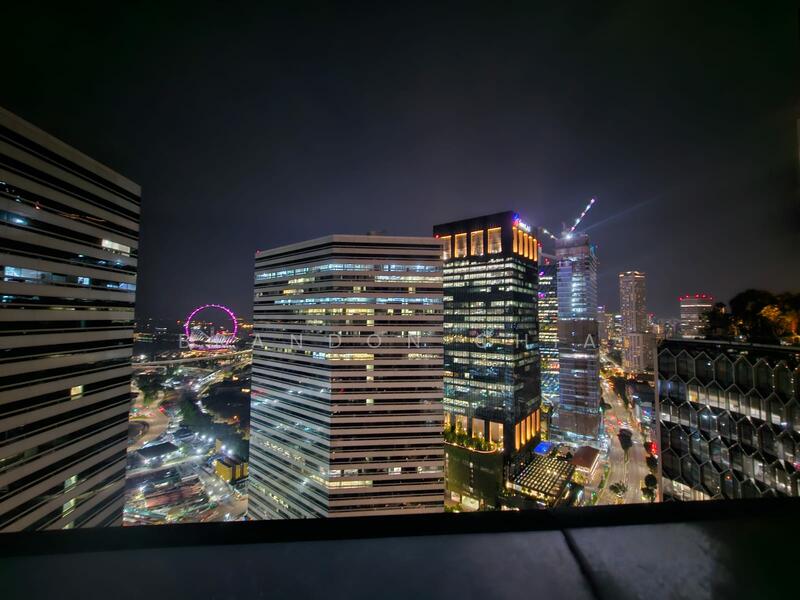
1 properties in DUO Residences
DUO Residences represents a strategically positioned investment in the heart of Bugis, one of Singapore's most vibrant mixed-use districts, which continues to command strong demand from both owner-occupiers and investors despite recent market cooling. The development's proximity to dual MRT stations (DT14 Bugis and EW12 Bugis) at just 110 metres places it within the highly desirable core central zone, where property values have shown resilience even during market downturns. Current market sentiment suggests that prime urban residences with exceptional transport connectivity remain attractive to foreign investors and high-net-worth individuals, making now a reasonable entry point before potential interest rate stabilisation and continued urban regeneration in the Bugis precinct drive values upward.
At approximately S$2.38 million for a 2-bedroom unit, DUO Residences positions itself at the premium end of the Bugis residential market, reflecting its freehold or near-premium tenure status and exceptional MRT proximity. Comparable developments in the immediate vicinity, such as those along Raffles Boulevard or within the City Fringe planning area, typically trade in the S$1.8M to S$2.8M range for similar-sized apartments, with pricing variations driven largely by exact MRT distance and development maturity. DUO's pricing appears justified given its location within Singapore's most transit-dense area and proximity to the Arts and Culture precinct, which has proven to maintain stronger capital appreciation relative to less accessible Bugis addresses.
DUO Residences is ideally suited for high-net-worth individuals and institutional investors seeking a trophy asset in Singapore's most connected urban zone, particularly those with medium to long-term holding horizons of 5+ years. The development appeals to both owner-occupiers who work in the CBD or Central Business District and investors targeting the expanding expat and regional investor demographic attracted to central Singapore prime locations. Additionally, developers and institutional real estate funds have shown sustained interest in freehold or long-tenure residential holdings in this precinct, viewing them as hedge assets against currency depreciation and Singapore's limited freehold supply.
Foreign investors purchasing a residential property at DUO Residences would be liable for ABSD at the rate of 20% on the purchase price, in addition to the standard Buyer's Stamp Duty of 3% on the first S$180,000 and 4% thereafter, making the total stamp duty burden substantial on a S$2.38M transaction. This equates to approximately S$476,000 in ABSD alone, plus an additional S$88,320 in standard stamp duty, representing a combined ~24% stamp duty cost that significantly impacts the total acquisition cost and effective yield for foreign purchasers. Some foreign investors structure purchases through Singapore-incorporated companies to potentially reduce exposure, though such arrangements require careful tax and legal structuring to remain compliant with IRAS guidelines and avoid future complications.
Investors in DUO Residences can typically expect gross rental yields in the region of 2.5% to 3.2% annually, reflecting the premium pricing of central location properties and the relative scarcity of rental demand at ultra-prime price points above S$2.3M. The tenant profile for units at this price level tends to skew towards multinational executives, diplomats, and high-earning professionals with employer-sponsored housing budgets, meaning void periods are generally minimal, though the absolute rental pool remains smaller than mid-market segments. Net yields after accounting for property tax, maintenance charges, and agent commissions typically settle between 1.8% to 2.4%, which is considered respectable for a freehold or long-tenure trophy asset in Singapore's most connected location, though below yields achievable in more affordable suburban precincts.
The proximity to Bugis MRT—at just 110 metres or approximately one minute walk—is fundamental to DUO Residences' valuation premium and represents one of the most significant value drivers in Singapore's residential property market. Properties within 200 metres of a major MRT interchange (DT14/EW12 Bugis is dual-line) typically command 15% to 25% price premiums over similarly specified units located 400+ metres away, due to superior tenant attractability and stronger capital appreciation trajectories. This exceptional connectivity also provides inherent inflation-hedging characteristics, as transport accessibility only increases in value as Singapore densifies and car ownership becomes less necessary; units at this MRT distance have historically outperformed broader market indices during both appreciation and recession cycles.
The Bugis and City Fringe precinct has limited remaining freehold or long-tenure residential supply, with most future completions likely to be located slightly further afield in areas like MacPherson, Tai Seng, or Potong Pasir, which do not directly compete with DUO's ultra-prime positioning. Singapore's Urban Redevelopment Authority (URA) Master Plan designates the immediate Bugis vicinity for mixed-use, heritage, and entertainment purposes rather than substantial new residential development, meaning supply constraints in DUO's immediate competitive set are likely to persist. This supply scarcity, combined with freehold or long-tenure tenure, should provide upside protection for DUO investors, though any large-scale mixed-use development launch within 400 metres could temporarily suppress sentiment and create short-term pricing pressure.
If DUO Residences is freehold or holds a 999-year lease (a common configuration for prime central developments), tenure should not be a material concern and actually represents a significant value-protection feature compared to 99-year leasehold properties that begin depreciating in value below approximately 70 years of lease remaining. Many investors and owner-occupiers specifically target freehold or ultra-long-tenure properties in the central zone as generational wealth preservation vehicles, particularly given Singapore's limited freehold supply in the prime residential market. Prospective buyers should verify the exact tenure structure (freehold vs. 999-year lease vs. 99-year lease) with the developer or their legal counsel, as tenure length directly impacts both capital appreciation and financing accessibility, with certain mortgagees declining to lend against 99-year leases below 80 years remaining.
When evaluating units, prioritise exposure and orientation (units facing the heritage Bugis Street or overlooking the Malay Heritage Centre command significant premiums), ceiling heights and internal layout efficiency (common limitations in freehold or heritage-adjacent developments due to building envelope restrictions), and the precise positioning relative to MRT exit points and pedestrian flow corridors. Critically assess the common property facilities, management standards, and maintenance charge trajectories, as premium central properties often experience higher-than-average service costs owing to heritage conservation requirements and the building's urban location; review 3-5 years of actual maintenance records if possible. Additionally, verify the developer's reputation, building's structural soundness and any ongoing legal disputes or defects, confirm financing pre-approval given the high purchase price, and assess the impact of the proximity to commercial/entertainment venues (potential for noise or weekend congestion) on personal lifestyle preferences.
The current market cycle presents a nuanced opportunity for purchasers at DUO Residences; whilst overall HDB and mass-market private residential prices have softened, ultra-prime central properties with exceptional connectivity have demonstrated greater resilience and relative outperformance, suggesting selective opportunities for well-timed investors. Interest rates have stabilised around 3.5% to 3.75% on most mortgage products, making financing costs predictable and not excessively punitive for cash-rich buyers, though the high purchase price and ABSD liability mean total acquisition costs remain substantial. For renters, Bugis properties have seen modest rental adjustments downward in 2024 as the expat workforce adjusted post-COVID and remote work matured, creating a window for quality negotiation on lease terms; however, supply constraints and DUO's premium positioning suggest rental stability is likely, making now neither exceptionally favourable nor disadvantageous for tenants seeking long-term occupancy.
Free Property Valuation
Enter your postal code and get a free instant valuation report straight to your inbox.