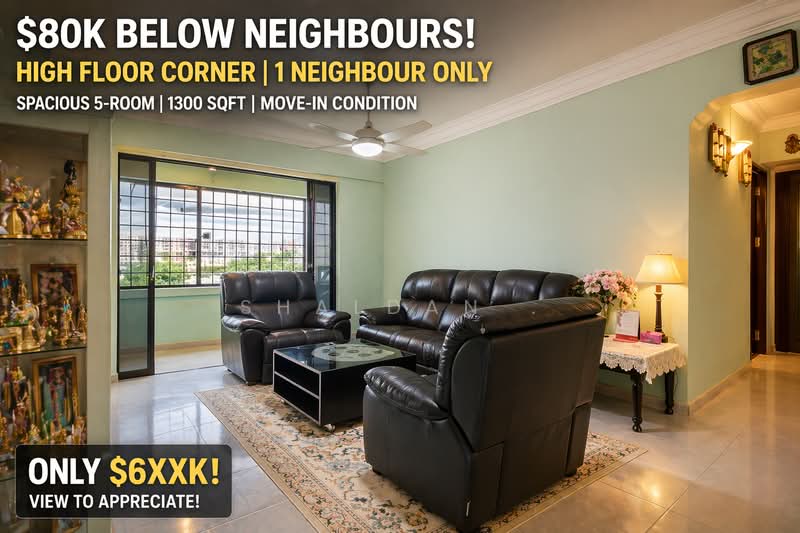
1 properties in Yio Chu Kang MRT
Yio Chu Kang MRT station (NS15) serves as a strategic interchange point on the North-South Line, making properties within its catchment relatively resilient during market corrections. The 7-minute walk distance from units like those on Ang Mo Kio Avenue 5 positions buyers in a sweet spot where they enjoy MRT convenience whilst potentially avoiding peak pricing seen in more central locations. Current market sentiment favours mature estates with established infrastructure and stable tenant demand, making this category particularly attractive for first-time buyers seeking value rather than speculative capital appreciation.
HDB resale prices in the Yio Chu Kang catchment have generally appreciated at a moderated pace of 2-4% annually, tracking slightly below the broader HDB market growth of 3-5% during the same period due to the estate's mature classification and higher average unit ages. Properties positioned within 10 minutes' walk of the MRT station have demonstrated stronger price retention than those further afield, suggesting that proximity to NS15 acts as a meaningful value anchor. The relative stability in this segment contrasts with volatile price swings in newer or more speculative neighbourhoods, appealing to conservative investors prioritising capital preservation over aggressive gains.
First-time HDB buyers aged 25-35, young families with school-aged children, and upgraders from smaller flats represent the core demographic for this catchment, as they prioritise affordability, MRT connectivity, and established community amenities over luxury finishes. Investors targeting stable rental yields rather than short-term flipping also favour this location, given the consistent demand from workers commuting to the city centre via the North-South Line. The presence of nearby schools, hawker centres, and recreational facilities such as Yio Chu Kang Park makes this particularly attractive to families seeking a balanced lifestyle without the premium pricing of central or waterfront estates.
A S$695,000 flat in this catchment typically qualifies for HDB loans of up to S$513,000 (70% of valuation for first-time buyers) or standard bank mortgage of S$522,500, leaving a down payment requirement of S$172,500 to S$182,500 when including stamp duty and legal fees. For a household with a combined monthly income of S$9,000 to S$12,000, servicing a S$400,000 to S$450,000 mortgage remains comfortably within the 30% debt service ratio threshold set by financial institutions. First-time buyers should factor in additional costs including Option Fee (0.5-1% of purchase price), legal fees (approximately S$800-1,200), and survey fees, reducing effective purchasing power by roughly S$15,000 to S$20,000.
HDB flats are exempt from ABSD under current regulations, making this category significantly more attractive to investors compared to private property purchases where ABSD ranges from 5% to 30% depending on citizenship and number of properties owned. This exemption means that an investor purchasing the S$695,000 flat pays only standard Buyer's Stamp Duty of S$12,490 (at the 1.8% rate for properties in this price range), substantially reducing entry costs relative to private condominiums or landed properties. The absence of ABSD creates a natural competitive advantage for HDB investments within this catchment, particularly for non-citizen investors seeking yield exposure without prohibitive additional taxes.
Properties in the Yio Chu Kang catchment typically generate gross rental yields of 3.0-3.8% annually, based on prevailing market rents of S$1,800 to S$2,200 per month for a standard 4-room HDB flat, which represents a solid yield for mature estate property. Vacancy risk remains relatively low at 2-4% due to consistent demand from working professionals, young couples, and relocated families attracted by the combination of MRT accessibility and affordable rents compared to city-centre alternatives. However, investors should account for potential yield compression as the estate continues to age and newer developments come online, with some properties experiencing stagnant or declining rents over the past 12 months in oversupplied pockets of Ang Mo Kio.
Properties within a 5-minute walk (approximately 400 metres) of Yio Chu Kang MRT command a price premium of 3-5% relative to units located 10-15 minutes away, reflecting the substantial convenience advantage for daily commuters and the reduced reliance on feeder buses. The valuation uplift is particularly pronounced for 4-room and 5-room flats targeting working professionals, where the MRT premium translates to approximately S$20,000 to S$35,000 on a S$695,000 property, making MRT-adjacent units more attractive to buyer pools and widening potential tenant audiences. This proximity advantage also provides better downside protection during market downturns, as MRT-linked properties retain buyer interest and rental demand more readily than peripheral units, effectively reducing liquidity risk.
The Housing & Development Board has indicated limited new HDB launches directly within the Yio Chu Kang catchment for the next 2-3 years, with most new supply focused on outer fringe areas such as Tengah and Sengkang, thereby reducing direct competitive pressure on existing resale stock. Private residential development activity remains minimal in this mature HDB estate, with most new private launches concentrated in nearby Serangoon or further north, suggesting the Yio Chu Kang catchment will maintain its character as a stable, fully-developed neighbourhood without disruptive new supply. This constrained pipeline scenario generally supports price stability and rental demand for existing HDB stock, although it does limit opportunities for new amenities or infrastructure upgrades that might enhance the area's appeal over the medium term.
Most HDB flats in the Yio Chu Kang area were built during the 1980s to early 2000s, meaning typical lease remaining periods range from 55 to 75 years, which significantly impacts resale value and mortgageability as flats approach the 80-year and 85-year thresholds. Banks generally reduce loan eligibility substantially once lease tenure falls below 60 years, and this restriction becomes critical when the property drops below 50 years, potentially limiting your pool of future buyers if you decide to sell. The HDB's recent Enhanced Housing Loan (EHL) scheme and the Lease Buyback Scheme provide options to extend tenure or unlock value from older flats, but buyers should factor in the cost and complexity of such transactions (typically S$40,000 to S$80,000) when evaluating long-term ownership and investment returns.
Conduct a thorough inspection of structural condition, focusing on evidence of water seepage, cracks, or pest issues that are prevalent in older estates, and obtain a pre-purchase structural survey (approximately S$400-600) to identify costly defects before commitment. Verify the property's floor level and orientation to assess exposure to noise from the nearby MRT line, neighbouring roads, or industrial zones; units on lower floors or facing busy thoroughfares command rental discounts of 10-15% compared to prime units. Scrutinise the maintenance and sinking fund status through HDB records, as some older blocks carry accumulated deficits exceeding S$15,000 per unit, and cross-reference with the area's en bloc redevelopment history and government statements regarding potential compulsory acquisition or large-scale upgrading programmes that could affect future resale value.
Free Property Valuation
Enter your postal code and get a free instant valuation report straight to your inbox.