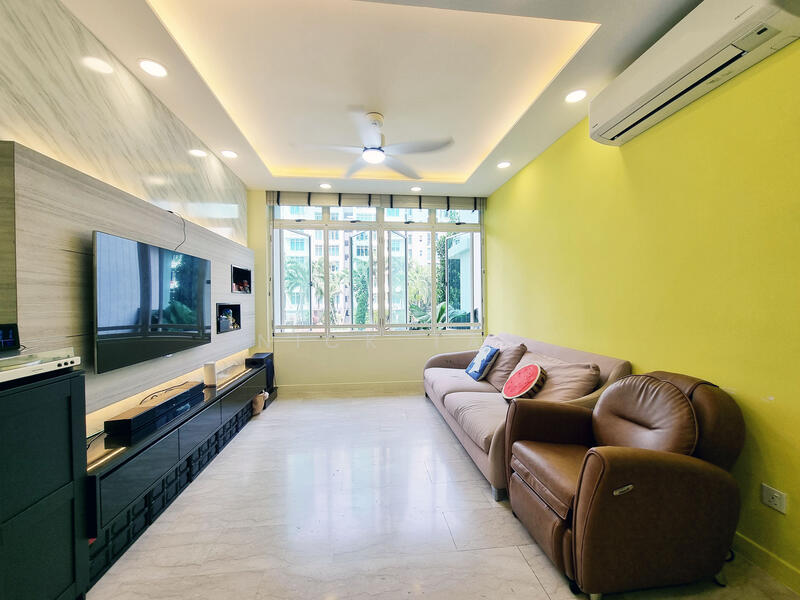
2 properties in Sengkang MRT
S$ 1,799,999
9 Sengkang Square · Condo · 3 min (240 m) from NE16 Sengkang MRT Station
S$ 1,820,000
74 Sengkang Square · Condo · 2 min (180 m) from NE16 Sengkang MRT Station
Sengkang remains one of the more affordable entry points on the North-East Line, with units around the S$1.8 million mark compared to the S$2.2–2.5 million range at Punggol and Hougang stations. The area has matured significantly since the MRT line opened in 2003, with established commercial amenities and schools, making it attractive for owner-occupiers seeking value rather than capital appreciation. However, buyer sentiment has been cautious in 2024 due to elevated interest rates and cooling measures, so negotiating power is stronger than it was in 2021–2022.
Prices in the Sengkang precinct have appreciated more modestly than central region areas and new launches in Punggol, with most resale transactions holding relatively flat since 2022 with 2–4% annual growth. The broader market saw a sharp spike in 2021–2022 driven by pandemic-era demand and ABSD exemptions for first-time buyers, but Sengkang's gains have been constrained by oversupply in the adjacent Punggol area and slower population growth compared to the city fringe. Compared to prime East Coast and Central locations, Sengkang has underperformed, though it continues to outpace older HDB precincts in the same corridor.
The core market comprises young families and upgraders aged 35–50 seeking a practical transition from HDB to condo ownership without stretching into the Marina Bay or Orchard corridor price bands. These buyers typically prioritise MRT proximity for commute efficiency to the CBD via the North-East Line, combined with access to the integrated Sengkang town centre amenities including retail, dining, and hawker options. First-time condo buyers from younger demographics also feature prominently, particularly those whose HDB flats have crossed the 30-year threshold and are exploring alternatives in the S$1.7–1.9 million range.
At this price point, a buyer securing a 75% LTV loan (maximum for non-first-time buyers post-2013 HDB) would require approximately S$450,000 in cash plus additional funds for ABSD, stamp duty, and legal fees, totalling roughly S$520,000 upfront. With mortgage rates hovering around 4.0–4.3% in 2024, monthly instalments for a 25-year tenure would run approximately S$2,800–3,000 per month, making this category accessible to household incomes above S$85,000 annually with manageable debt service ratios. First-time buyers benefit from 5% ABSD concessions and can leverage CPF for down payments, materially improving affordability compared to investors who face the standard 12–15% ABSD regime.
An investor purchasing a S$1.8 million unit at Sengkang MRT would incur Additional Buyer's Stamp Duty (ABSD) of 12% (S$216,000), plus conveyancing stamp duty of approximately 4–4.5% (S$72,000–81,000), totalling roughly S$288,000–297,000 in transfer taxes, or 16–16.5% of purchase price. By contrast, an owner-occupier buying their first residential property pays zero ABSD and only the standard conveyancing duty of 3–4% (approximately S$54,000–72,000), creating a meaningful cost advantage of roughly S$214,000 in favour of end-users. Second-time buyers or investors should model these taxes as carrying costs, noting that rental yields of 3.5–4.0% (discussed below) may not justify the ABSD burden unless capital appreciation is anticipated or a portfolio strategy is in place.
Condominiums in the immediate Sengkang MRT precinct typically command gross yields of 3.5–4.2% per annum, with monthly rents for a three-bedroom unit ranging from S$4,200–5,100 depending on unit condition and specific location within the development. Vacancy risk is moderate, as the MRT proximity and mature town centre infrastructure attract a steady pipeline of young professionals and expat renters commuting to the CBD, though the market is not immune to cycles; during economic downturns or oversupply phases in adjacent Punggol, vacancy can stretch to 8–12 weeks. Rental growth has averaged 2–3% annually over the past five years, moderating as immigration policies tightened and new-build competition from nearby projects like Punggol's mixed-use enclaves increased tenant choice.
Units within a 2–3 minute walk (approximately 150–250 metres) of Sengkang MRT station command a documented 5–8% price premium over identical units located 400–600 metres away in the same development or adjacent blocks. This premium reflects both commute convenience and perceived lifestyle value—properties marketed as 'MRT-adjacent' routinely achieve faster sale cycles (4–8 weeks versus 8–12 weeks for comparable units further back) and rental placements within 2–3 weeks of listing. The two sample listings (La Fiesta at 2 minutes and Compass Heights at 3 minutes) both fall within this premium envelope, positioning them as more competitive for time-sensitive buyers and securing more reliable tenant quality than units requiring a longer walk or feeder bus connection.
The Sengkang area is not designated for major new residential launches within the immediate station precinct, with most future supply concentrated in Punggol New Town (approximately 1.5–2 km away) and smaller infill projects in Buangkok and Yio Chu Kang. However, en bloc activity and land sales by JTC have been mooted for some mature industrial plots in Sengkang, and any residential conversion could add downward pressure on resale condo prices if large-scale projects emerge in 2025–2027. The maturity of the Sengkang MRT node (now 21 years operational) suggests that supply constraints will remain tighter than in Punggol, supporting a relative valuation floor, though forward planning should account for potential HDB new-town developments in adjacent planning areas that could dilute demand.
All condominiums in the Sengkang MRT precinct operate on either 99-year leasehold terms (for projects completed post-1995) or 103-year leases (rare, for earlier 1980s projects), meaning most current listings are between 75–80 years remaining—well within the mortgageability comfort zone where banks typically impose no additional restrictions. However, as lease tenure declines below 75 years (likely post-2040 for this cohort), refinancing becomes more stringent, with some institutions capping LTV ratios or increasing interest margins, and owner-occupiers should model lease decay as part of long-term affordability planning. Investors should be particularly alert, as rental yield calculations and exit value assumptions become less robust in the 60–70 year tenure window, potentially restricting future buyer pools to owner-occupiers or offshore investors willing to accept capital decline.
Beyond standard property inspections, buyers should verify the management corporation's reserve fund adequacy and any planned major works (particularly for projects approaching 20+ years old), as utilities and common area maintenance can trigger significant cash calls—particularly relevant for Sengkang given the age profile of the stock. Confirm the MRT station's actual walking route from the main entrance of the building, ensuring marketing claims of '2–3 minutes' align with real-world pavement conditions, any underpass usage, and weather shelter availability during peak commute hours. Cross-reference nearby planning documents on the Urban Redevelopment Authority website for any proposed MRT line extensions, rezoning proposals for adjacent land, or industrial activities (e.g. remaining light industrial uses in Sengkang proper) that could impact long-term amenity, noise, or future land value; also scrutinise the development's parking ratio (typically 0.8–1.2 lots per unit) and check whether EV charging infrastructure is planned or available, as this increasingly influences resale demand among younger buyers.
Free Property Valuation
Enter your postal code and get a free instant valuation report straight to your inbox.