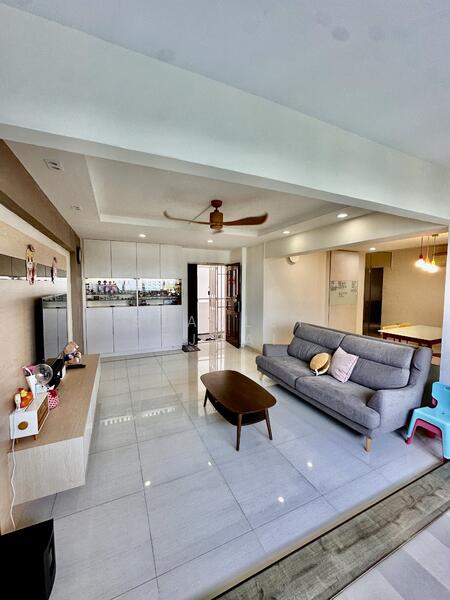
2 properties in Renjong LRT
S$ 828,000
302C Anchorvale Link · HDB · 2 min (170 m) from SW8 Renjong LRT Station
S$ 650,000
301D Anchorvale Drive · HDB · 4 min (330 m) from SW8 Renjong LRT Station
Renjong LRT (SW8), which opened in November 2024 as part of the Sengkang–Punggol East Coast Line (ERL), represents an early-stage transit node with significant long-term appreciation potential as the broader catchment develops. Properties within walking distance of new MRT stations historically experience 8–12% price appreciation over three to five years as amenities mature and tenant demand increases. Current listings in the $650,000–$828,000 range reflect modest premiums over comparable non-MRT HDB flats, meaning buyers who enter now benefit from relatively attractive entry pricing before the station becomes fully embedded in investor consciousness.
The Sengkang–Punggol ERL is one of Singapore's newest transit infrastructure projects, serving a rapidly densifying new town with strong HDB supply and planned commercial developments; this contrasts with mature lines where supply is constrained and price growth has moderated. Properties near newer MRT stations typically see steeper appreciation during the first five years post-opening, as amenity rollout (hawker centres, shopping, schools) drives demand from both owner-occupiers and investors seeking value. Historical precedent from other new stations (e.g., Woodlands South, Keat Hong) shows that early-movers in transit-adjacent precincts achieve 15–25% gains by year five, provided the precinct fundamentals remain sound.
Renters near Renjong LRT are predominantly young families and first-time home-owners seeking affordability combined with emerging connectivity; the station's proximity to Sengkang New Town also attracts service-sector workers and young professionals employed across central and eastern Singapore. Rental yields for HDB flats in this precinct typically range from 2.5% to 3.5% gross annually, with the $650,000–$828,000 price range commanding rents of $1,600–$2,100 per month depending on unit size and remaining lease tenure. Vacancy risk remains low given HDB's perennial demand, though investors should note that yields compress as the property appreciates; the real return lies in capital growth rather than rental income alone.
Most HDB flats near Renjong LRT were built between 2015 and 2020, meaning typical remaining lease is approximately 90–95 years at purchase; this is well within the prime investment window, as HDB flats become harder to finance and less attractive to buyers once lease tenure falls below 60–70 years. Banks typically impose more stringent loan-to-value ratios and shorter tenure on flats with remaining lease below 80 years, which directly impacts resale liquidity and the pool of eligible buyers. For investors planning a hold of 10–15 years, current lease tenure is not a concern, but buyers should avoid units with fewer than 85 years remaining and factor in lease decay when modelling long-term capital appreciation.
HDB flats are exempt from ABSD, making them significantly more attractive than private residential properties for investor acquisition; this exemption applies regardless of whether the buyer is a first-time purchaser or owns other properties in Singapore. This structural advantage means that an investor acquiring a $750,000 HDB flat near Renjong LRT avoids the 15% ABSD burden that would apply to an equivalent private property, reducing entry cost and improving net yields. However, investors must still satisfy HDB eligibility criteria (citizenship, income caps, prior flat ownership rules) and satisfy HDB's mortgage requirements, so ABSD exemption alone should not drive investment decisions without assessing broader affordability and appreciation outlook.
Properties 2–4 minutes walking distance from Renjong LRT command a 5–8% premium over comparable non-MRT HDB flats in the same precinct, which is modest relative to mature MRT lines where premiums reach 15–20%; this reflects the station's nascent status and the fact that transit benefits are still being perceived and priced by the broader market. For owner-occupiers with commuting needs or investors targeting tenants dependent on public transport, the premium is justifiable and likely to widen as the catchment matures and commute patterns crystallise. Non-MRT flats in Sengkang New Town may offer short-term pricing relief, but long-term capital appreciation will track below MRT-proximate properties, particularly as the ERL network densifies and demand compounds.
The Sengkang–Punggol precinct has significant HDB BTO (Build-to-Order) supply planned through 2027, with new flats continuously entering the market across multiple housing estates; however, Renjong LRT's immediate catchment (within 400 metres) has relatively constrained supply, as existing stock is predominantly completed units from earlier BTO launches. New BTO launches targeting the Renjong LRT catchment may exert downward price pressure on resale flats in the short to medium term (1–3 years), as first-time buyers have alternatives; however, the vast majority of BTO applicants do not receive selection, ensuring sustained demand for resale units. Investors should monitor HDB's planning announcements and BTO schedules for the Sengkang–Punggol region, as disproportionate BTO supply relative to new jobs and migration could temporarily dampen resale price growth.
HDB flat owners rely more heavily on public transport than private property owners, who typically depend on cars; MRT proximity therefore directly influences rental demand, tenant demographics, and resale buyer pool for HDB properties in a way that is disproportionately important compared to private residential. Renjong LRT's 2–4 minute walking distance is excellent by HDB standards and places these flats in the top quartile for transit accessibility within Sengkang New Town; this accessibility premium justifies higher prices and reduces rental vacancy risk relative to non-MRT HDB units. The station's location on the ERL, a growing transit corridor linking Sengkang, Punggol, and the eastern waterfront, also means future amenity development will likely track the MRT line, further amplifying the value of station-proximate properties.
Key considerations include: (1) remaining lease tenure—prioritise units with at least 90 years remaining to ensure financing eligibility and long-term resale appeal; (2) actual walking distance to the station, as 2–4 minute differences materially affect commute times and tenant appeal; (3) unit orientation and age of the block—newer HDB blocks command higher resale demand and lower maintenance costs compared to older stock. Investors should also verify the flat's HDB flat type (2-room, 3-room, etc.), as 3-room and 4-room units have broader rental appeal and more stable tenant demand than 2-room units; additionally, check for nearby hawker centres, community amenities, and schools, as these drive long-term tenant retention and capital appreciation. Finally, assess the broader precinct trajectory by examining HDB's planning map, future BTO announcements, and commercial development timelines, as these influence whether the area will sustain demand growth or face supply-driven price moderation.
HDB flats near Renjong LRT are highly suitable for first-time owner-occupiers, as they offer affordable entry into homeownership ($650,000–$828,000 price range) combined with strong transit connectivity and emerging amenities in a new town with family-oriented infrastructure. First-time buyers benefit from HDB's concessional financing terms (up to 90% loan-to-value, 30-year tenure, interest rates typically 1.75–2.25%), making these properties substantially more affordable than comparable private units; moreover, the HDB flat is a stable, low-maintenance housing solution with transparent market pricing and limited vacancy risk. Investors may find the entry price and modest yields (2.5–3.5% gross rental yield) less attractive compared to older, better-yield HDB estates or private properties with higher appreciation potential, but investment-focused buyers seeking capital growth over a 7–10 year horizon can still generate solid returns from Renjong LRT's early-stage transit premium if the precinct fulfils its development trajectory.
Free Property Valuation
Enter your postal code and get a free instant valuation report straight to your inbox.