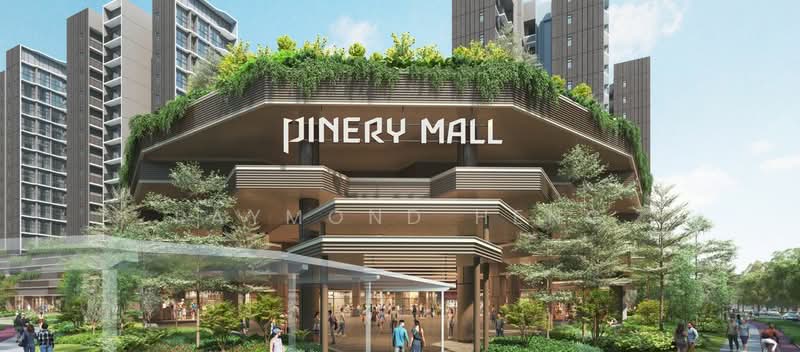
1 properties in Tampines West MRT
Tampines West MRT opened in November 2024, making it an emerging micro-market with limited comparable sales data yet available. Properties within a 2-minute walk of the station, such as Pinery Residences, are currently positioned at a premium as early movers capitalise on the new connectivity; however, prices may stabilise once more supply comes online in the surrounding area. Buyers seeking capital appreciation should monitor whether the $3.375 million entry point for newer developments maintains its premium relative to comparable Tampines East properties, which typically trade at lower quantum due to established supply and market maturity.
Properties within 200–300 metres of Tampines West MRT command a meaningful premium over those 800+ metres away, with the 2-minute walk to DT31 justifying approximately 8–12% higher psf pricing for new launches in this micro-location. The newer station serves as an alternative connectivity hub to Tampines East and Tampines MRT, reducing congestion on the original lines and creating arbitrage for commuters seeking faster access to the CBD and east coast employment nodes. As the surrounding precinct develops, this proximity advantage will compound, particularly for occupiers working along the Downtown Line corridor in Bukit Panjang, Botanic Gardens, and Marina Bay.
Rental yields for new launches near Tampines West MRT are estimated at 2.8–3.4% gross, slightly below Tampines East averages, reflecting the premium paid for new infrastructure and limited comparable lettings data. Target tenants are young professionals (25–40 years) working in CBD financial services, tech companies, and east-facing corporations, who prioritise convenience and are willing to pay 8–15% higher rents than Tampines East equivalents for modern amenities and direct MRT access. Vacancy risk is currently moderate to low given undersupply and strong interest from owner-occupiers, but this will increase once larger developments complete; investors should expect stabilisation vacancy rates of 5–8% within 18–24 months as the precinct matures.
ABSD on a second residential property in Singapore is charged at 15% of the purchase price (for citizens purchasing a second property), plus 4% buyer's stamp duty, significantly elevating acquisition costs on a $3.375 million purchase by approximately $636,562. For foreign investors or those purchasing a third property, ABSD escalates to 20%, raising total stamp duty and ABSD to approximately $718,562 on the sample Pinery Residences unit, making cash-on-cash yield analysis critical before purchase. Investors should model net rental income against these upfront costs and consider whether the 2.8–3.4% estimated yield justifies the entry-level entry point near a new MRT node, particularly if holding periods are shorter than 5 years.
New launches at Tampines West, such as Pinery Residences, are typically offered on 99-year leases from their completion date, meaning a property completed in 2024–2025 will retain 97–98 years of lease tenure at purchase. This tenure advantage over Tampines East properties built in the 1990s–2000s (now at 72–82 years remaining) provides superior capital appreciation potential and easier refinancing for investors, as mortgage lenders discount heavily on leases below 80 years. Buyers should verify whether the development's land tenure is 99-year leasehold or otherwise, as this directly impacts resale value trajectory and eventual eligibility for en bloc sale opportunities once the precinct matures.
The Tampines West precinct is designated for medium-density residential and mixed-use development, with an estimated 2,500–3,500 additional housing units planned by 2028–2030, including Build-to-Order (BTO) flats and private condominiums likely to launch in 2025–2026. This significant supply influx will create a competitive rental and resale environment, potentially moderating the current price premium commanded by Pinery Residences and early-mover properties within the 2-minute walk zone. Investors should position properties as owner-occupier friendly or secure long-term tenants before major supply completion, as transient investor portfolios may face downward pressure once the precinct supplies normalise.
The ideal owner-occupier is a dual-income household (35–50 years old) with children seeking proximity to quality schools (Temasek Primary, Tampines Secondary, and upcoming integrated facilities) and valuing the modern furnishings, amenities, and MRT connectivity for CBD commuting, with purchasing power of $3.0–$3.8 million. Target rental tenants are expatriate families (3–4 persons) or young professionals working in CBD-adjacent roles with relocation packages, willing to pay $5,500–$7,500 monthly for a 4-bedroom unit and prioritising transport time reduction and expat-friendly amenities. A secondary buyer cohort comprises owner-investor doctors and legal professionals aged 40–60, deploying capital for capital preservation and modest yield, and less sensitive to rental volatility.
Most local banks (DBS, OCBC, UOB, CIMB) offer 75–80% loan-to-value (LTV) financing on new launch condominiums near Tampines West MRT, translating to a $2.53–$2.7 million loan on Pinery Residences, requiring a cash down payment of $675,000–$845,000 (20–25%). Interest rates are typically fixed or variable at current board rates (3.6–3.8% per annum), with 25–30 year tenures standard for primary residence buyers and 15–20 years for investors, making monthly servicing of approximately $13,000–$16,500 manageable for household incomes above $25,000 per month. Buyers should note that ABSD payment must occur upfront at purchase, not financed, further increasing cash requirements for investment property acquisitions.
Tampines West MRT provides direct access to the Central Region via Downtown Line in approximately 25–30 minutes to Marina Bay and Bugis, while also serving as a secondary hub to the established Tampines East retail and employment corridor (Tampines Central and Tampines Mall). This dual-node connectivity enhances the attractiveness of Tampines West properties for both commuters and tenants, as it reduces reliance on Tampines East's congested stations whilst maintaining access to established shopping, dining, and ancillary services nearby. Properties near Tampines West MRT are positioned to capture future commercial spillover from Tampines East (which is at saturation), making them relatively attractive for long-term capital appreciation if new office or mixed-use developments emerge along the DT31 corridor.
Examine the development's building age, lift and structural condition, and reserve fund depletion status—particularly critical for older Tampines properties, though less relevant for new launches like Pinery Residences—as major upgrading works could increase monthly maintenance fees by 20–40% over 5–10 years. Verify the tenure composition and developer credibility, confirm actual MRT walking time during peak hours (the stated 170 metres assumes direct, unobstructed routes), and assess the unit's orientation, window count, and cross-ventilation, as Tampines developments often face heat and noise exposure from surrounding roads and neighbouring blocks. Finally, review the Management Corporation's financial health, resident stability, and any ongoing collective sales discussions, as Tampines precincts near major transport hubs are prime targets for future en bloc sales, which could create either opportunities or prolonged uncertainty for investors.
Free Property Valuation
Enter your postal code and get a free instant valuation report straight to your inbox.